

words: Francesco De Napoli
Godfrey Reggio, best known for the “Qatsi” trilogy (Koyaanisqatsi, 1982; Powaqqatsi, 1988; and Naqoyqatsi, 2002), offers with this 2013 film what might be described as a rigorous exercise on the gaze and on the temporality of perception. These lines are not intended as a review, but rather as a reflection that the film, in some way, compels us to undertake.
If it is true that we can contemplate a photograph for an indefinite period of time, determined by ourselves, it is equally true that cinema is far more capable of regulating the temporality of our gaze. It is therefore compelling to consider that photography must – or perhaps can – learn (or rather re-learn) from cinema the temporality of the gaze.
Although there are twenty-four “photographs” per second¹ passing through the projector of a movie theater, they are capable of remaining “still” more than a single photograph on any of our devices. The image that scrolls – or rather, that we make scroll – is too fleeting to leave a trace or to activate conscious thought.²
¹ This was the case with celluloid film; with the advent of digital technology, the frame rate has increased and is, in most cases, variable between 24 and 60 fps.
² In 1936 Walter Benjamin wrote: “[…] they have anticipated a situation that Paul Valéry describes with the following words: ‘Just as water, gas, or electricity are brought into our homes from far away, with minimal effort, to satisfy our needs, so too shall we be supplied with images and sequences of sounds, which appear at the slightest gesture, almost a sign, and then immediately leave us.’” – 1934! [editor’s note]. The Work of Art in the Age of Its Technological Reproducibility, in Selected Writings, Vol. 3 (Cambridge, MA: Harvard University Press). Original title: Das Kunstwerk im Zeitalter seiner technischen Reproduzierbarkeit.
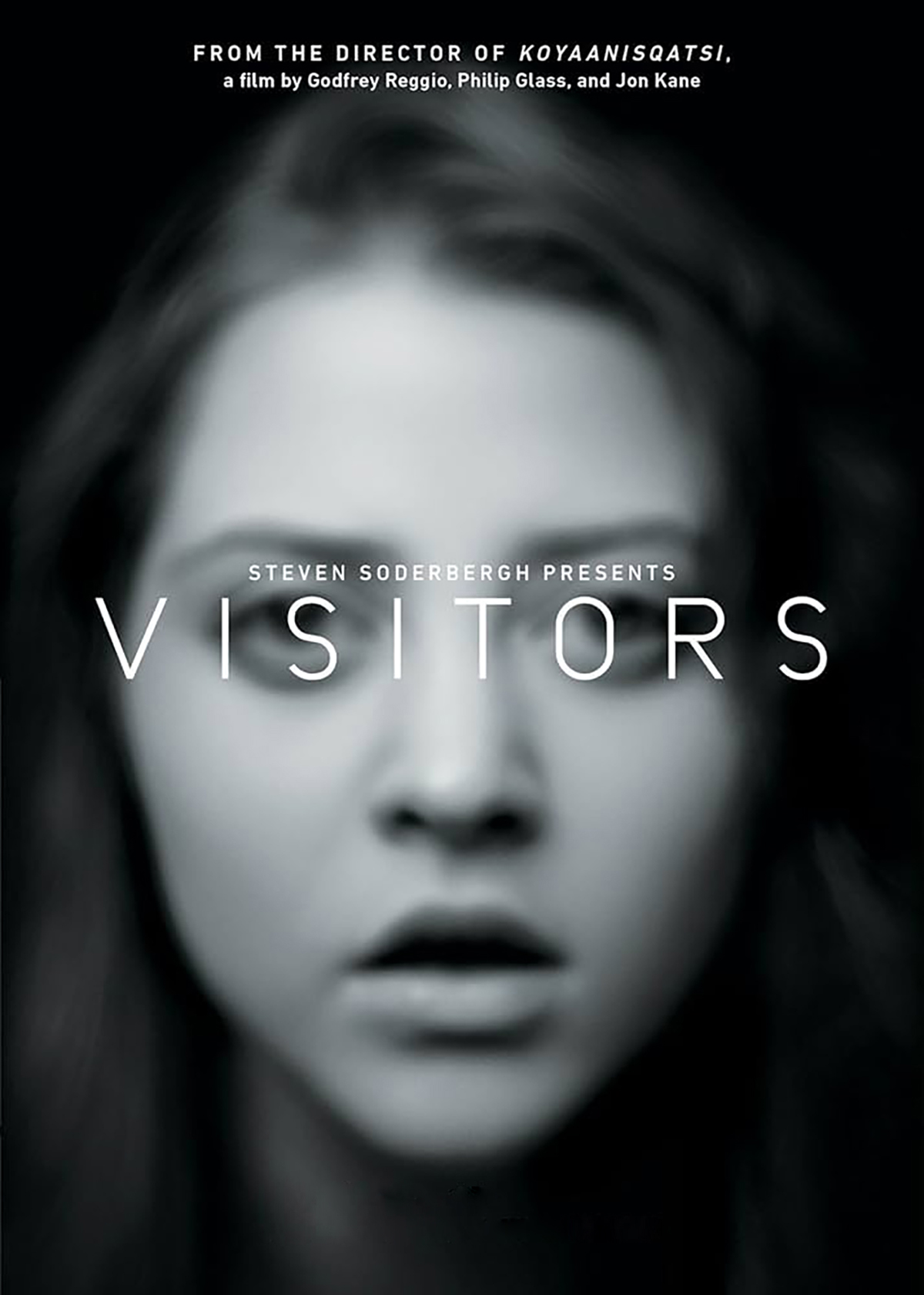
Visitors presents a film in which a series of slow-motion portraits unfold, interspersed with other images. They function as a form of punctuation that runs throughout the entire film. It is on these essentially “static” portraits – particularly those in the first part of the film (as it progresses, they become increasingly dynamic) – that I wish to dwell.
These portraits last between approximately one and two minutes – an immense duration both for a cinematic shot and for the ordinary experience of a static image. And this is precisely their strength. Although the gaze and expression of each subject remain essentially neutral, we begin to perceive them in turn as suffering, inquisitive, judgmental, indifferent, serene – passing through every possible nuance of expression.
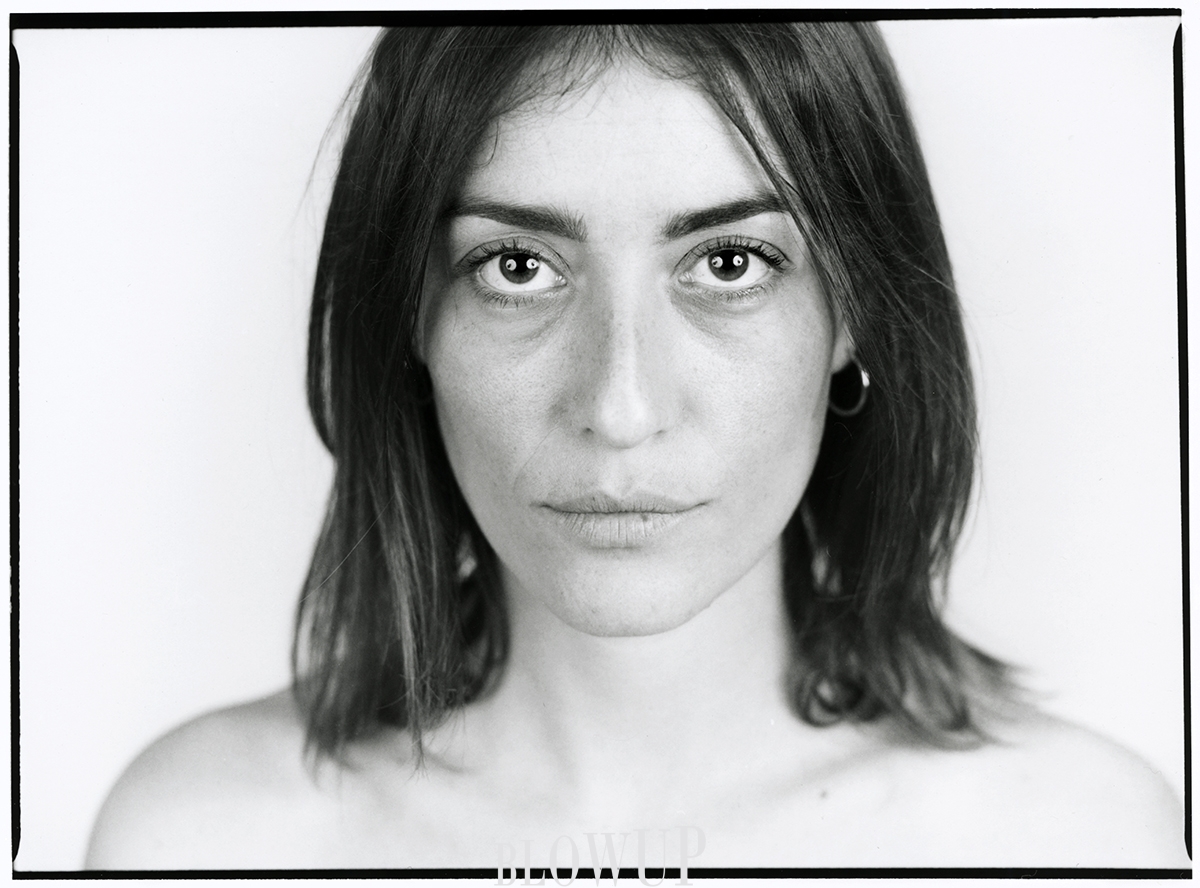
If we linger long enough before a photographic portrait constructed around the neutrality of face and gaze (August Sander, Walker Evans)³, it produces the same effect as the portraits in Reggio’s film. We begin to see a multitude of expressions unfolding over time upon that face. And yet, the photograph remains unchanged.
³ The serious posed portrait has become increasingly rare. As Olivier Lugon writes: “Thus a complete reversal in the definition of naturalness in photography becomes apparent. Spontaneity is now stigmatized as falsification: in an activity as specific and inherently unsettling as photographic portraiture, naturalness can only be artificial. […] This argument is taken up again by Lincoln Kirstein with regard to Evans. In American Photographs, his praise of the photographer is preceded by a severe critique of the pursuit of spontaneity in photography, in which he describes the unposed snapshot (candid camera) as ‘the greatest liar in the photographic family.’” Olivier Lugon, The Documentary Style in Photography: From August Sander to Walker Evans, 1920–1945 (original title: Le style documentaire. D’August Sander à Walker Evans 1920–1945).

This implies that the longer the duration of viewing, the greater the possibilities for interpretation—not only in portraiture. I refer to portrait photography because the act of looking and being looked at—knowing how to look and how to look at oneself, both for the photographer and for the subject—seems to have become increasingly uncomfortable and demanding. We do it less and less, and for ever shorter periods of time; the excuses for averting our gaze multiply.
Cinema allows us to look without being looked at—so why not make use of the apparently “unidirectional” condition offered by this (though not only this) film?
And when speaking of cinema—thus of the “big screen”—one must also consider the sites of reception, whose proliferation has fostered a fragmented, almost schizophrenic attitude toward viewing: between the large and the small screen, the art gallery, the museum, and the mobile device. This marks a further step beyond what Walter Benjamin articulated in 1936 in The Work of Art in the Age of Its Technological Reproducibility.⁴
⁴ “The circumstances into which the product of technological reproducibility may be brought may leave the intrinsic quality of the work of art untouched—yet they nonetheless entail the devaluation of its hic et nunc.” Walter Benjamin, The Work of Art in the Age of Its Technological Reproducibility, op. cit., p. 23.
An image, if it is not an icon—though we should avoid oversimplification—is something more complex, to be read in the totality composed of its various parts. One might think of works such as Guernica by Pablo Picasso or, returning to photography, the images of Gregory Crewdson. Crewdson employs the means of cinema, yet he does not have at his disposal the temporal succession of shots and frames through which that medium directs our gaze, telling us what to look at and in what order.
It is emblematic—and perhaps somewhat troubling – that Crewdson himself, on his official Instagram profile (@crewdsonstudio), has produced short videos to “explain” the meaning of the various “portions” of his images, highlighting an internal narrative that is not immediately evident, largely because of the scale and nature of contemporary viewing supports.
And yet, this awareness has always existed. What was a “TV film,” if not a film conceived specifically for the dimensions of the small television screen, where it was impossible to fully experience the complexity of shots designed for the cinema?
It is an illusion to believe – though this is precisely how we tend to think, and we all pay the price in terms of quality – that a work remains identical regardless of the medium through which it is reproduced.
The time within and of cinema seems to restore dignity to the gaze, and Visitors stands as a compelling example of this restoration.